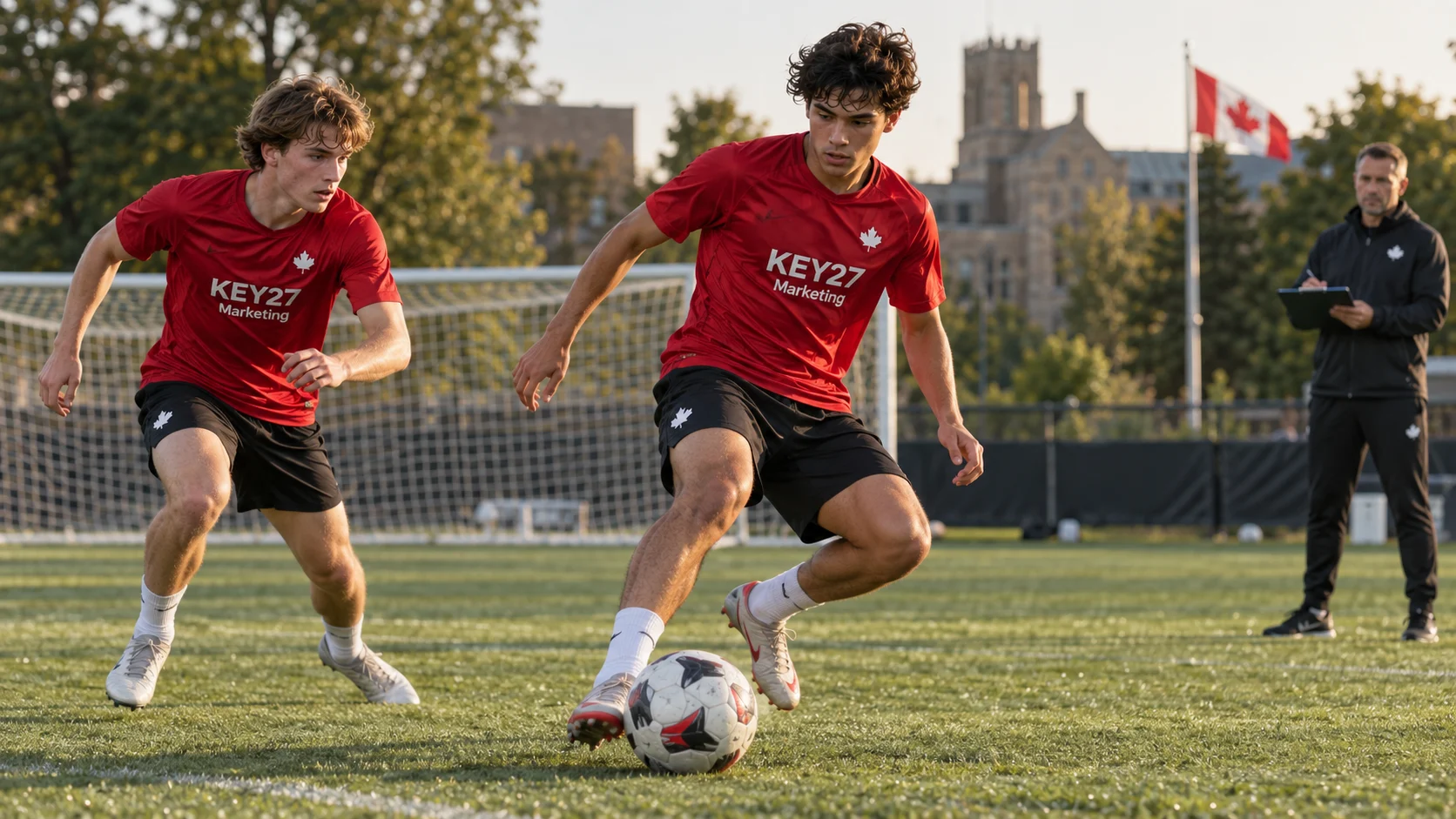
Getting interest from a U.S. college coach is exciting, but recruiting is only one part of becoming a college student-athlete.
Canadian athletes also need to manage:
- university admission
- NCAA eligibility
- academic documents
- athletic certification
- financial aid
- immigration and student-status requirements
These processes are connected, but they are not the same thing.
A coach can want you on the team without being able to guarantee university admission. You can be admitted academically without yet being cleared to compete by the NCAA. And receiving recruiting interest does not automatically mean you have received an athletic scholarship.
Understanding these separate steps can help Canadian families avoid delays and last-minute surprises.
This guide explains the main process for Canadian athletes applying to U.S. colleges, particularly those pursuing NCAA opportunities.
Summary
Canadian athletes applying to U.S. colleges should understand five separate parts of the process:
- Recruiting: A coach evaluates whether you fit the athletic program.
- Admissions: The university determines whether you qualify academically for admission.
- Athletic eligibility: The NCAA Eligibility Center determines whether you satisfy applicable academic and athletics requirements.
- Financial aid: The school determines your athletic scholarship, academic aid and other financial assistance.
- Student status: After admission, international students need the appropriate documents to legally study in the United States.
For NCAA Division I and II, Canadian athletes generally need an Academic and Athletics Certification Account with the NCAA Eligibility Center. International athletes entering Division III generally need athletics certification as well.
The best approach is to start early, keep documents organized and treat recruiting, admissions and eligibility as parallel processes rather than waiting for one to finish before beginning the next.
In This Guide
- Recruiting and College Admission Are Two Different Processes
- Understand Your Athletic Eligibility Requirements
- Prepare Your Academic Records and Documents
- Apply to the College or University
- Complete Required Athletic Eligibility Steps
- Understand Scholarships and Financial Aid
- What Canadian Students Should Prepare Before Leaving for the U.S.
- Frequently Asked Questions
Recruiting and College Admission Are Two Different Processes

One of the most important things for families to understand is that:
Being recruited does not automatically mean you are admitted to the university.
The athletic department and admissions office have different responsibilities.
The Coach Evaluates Your Athletic Fit
A coach may evaluate:
- athletic ability
- position
- statistics or results
- video
- physical development
- competition level
- character
- roster needs
If the coach believes you fit the program, recruiting conversations may become more serious.
But the coach is not necessarily the person making the final admissions decision.
The University Evaluates Your Academic Application
The admissions office may consider:
- high-school grades
- courses completed
- graduation requirements
- academic program requirements
- essays or supplemental applications
- English-language requirements where applicable
- other institution-specific criteria
The exact requirements vary from university to university.
That means an athlete should research academic fit at the same time as athletic fit.
Do not build a recruiting list based entirely on teams you want to play for.
Also ask:
- Does the university offer the program I want?
- Are my grades realistic for admission?
- Are there specific prerequisite courses?
- What are the application deadlines?
- Does the school have additional requirements for Canadian applicants?
If you are still at the earlier recruiting stage, first review how the U.S. college sports recruiting process works for Canadian athletes.
Understand Your Athletic Eligibility Requirements
If you want to compete in NCAA sports, eligibility is another process separate from admission.
The NCAA Eligibility Center reviews both:
academic eligibility
and
athletics eligibility.
Its role is to determine whether an athlete can practice, compete and receive athletics aid under NCAA rules.
NCAA Division I
Current Division I academic requirements include:
- 16 NCAA-approved core-course credits
- a minimum 2.3 NCAA core-course GPA
- high-school graduation
- NCAA academic certification
- NCAA athletics certification
The NCAA core-course GPA is not necessarily the same as the GPA shown on your Canadian transcript.
It is calculated using courses the NCAA accepts as core academic coursework.
An Important Canadian Exception
The standard Division I rules include a requirement commonly referred to as 10/7, under which domestic students normally need to complete 10 core courses before senior year, including seven in English, math or science.
Students with solely international academic credentials, including Canadian credentials, are not required to satisfy the 10/7 rule.
Canadian athletes still need to satisfy the applicable 16-core-course and GPA requirements.
NCAA Division II
Division II also requires 16 core courses but uses a minimum 2.2 core-course GPA for initial eligibility.
NCAA Division III
Division III works differently.
Division III schools establish their own academic admission standards and do not use NCAA academic certification in the same way as D1 and D2.
However, international Division III student-athletes need to register with the NCAA Eligibility Center for athletics certification.
This matters for Canadian athletes because NCAA eligibility requirements depend partly on the division you ultimately choose.
Prepare Your Academic Records and Documents

Do not wait until the end of Grade 12 to start organizing documents.
The NCAA warns that missing transcripts, proof of graduation or other required records can delay certification.
Your High-School Transcript
The NCAA Eligibility Center reviews academic records beginning with Year 9.
For international athletes, official academic documents generally need to be submitted by the secondary school or appropriate issuing authority rather than simply uploaded by the athlete.
Your transcript should show:
- courses completed
- grades
- years attended
- graduation information when completed
If your academic records are not in English, the NCAA may also require a certified line-by-line English translation.
For most Canadian students studying in English-language schools, the transcript itself will already be in English.
Canadian Academic Systems Differ by Province
The NCAA provides country-specific academic information for Canadian provinces and territories, including separate guidance for:
- Alberta
- British Columbia
- Manitoba
- New Brunswick
- Newfoundland and Labrador
- Nova Scotia
- Ontario
- Prince Edward Island
- Quebec
- Saskatchewan
- the territories
This is important because Canadian education systems are provincial rather than national.
A student graduating from an Ontario high school may therefore have different credential documentation than a student coming from Quebec.
Families should use the NCAA guidance corresponding to the athlete’s actual educational system.
Proof of Graduation
After you graduate, the NCAA requires a final official academic record that includes proof of graduation.
Do not assume your earlier transcript automatically completes the process.
Your Eligibility Center account may still show outstanding tasks after graduation.
Keep Your NCAA ID Available
Once registered, you will have an NCAA ID.
Share it with schools recruiting you so their athletics compliance staff can connect your eligibility record with the university.
The NCAA specifically recommends giving your NCAA ID to recruiting schools so they can place you on their institutional request list.
Apply to the College or University
Recruiting activity and university applications often happen at the same time.
Do not assume that because a coach knows who you are, the university application happens automatically.
Confirm the Application Method
Depending on the university, you may apply through:
- the university’s own application
- the Common Application
- another application platform
Ask the coach or admissions office whether recruited athletes follow any specific process.
Know Your Deadlines
Deadlines may differ for:
- Early Decision
- Early Action
- Regular Decision
- rolling admission
- scholarship consideration
Recruiting timelines and admission timelines do not always match perfectly.
A coach may still be evaluating you when an important admissions deadline approaches.
Do not miss a deadline because you are waiting for another recruiting conversation.
Submit the Required Academic Materials
The university may require documents separately from the NCAA Eligibility Center.
This is an important distinction.
Sending a transcript to the NCAA does not necessarily mean the university admissions office has received everything it needs.
You may need to provide:
- official transcripts
- predicted or current grades
- final grades
- graduation confirmation
- course information
- supplemental documents
Always follow the individual university’s admissions instructions.
Check Program-Specific Requirements
Admission to the university may not automatically mean admission to every academic program.
Programs such as:
- engineering
- business
- nursing
- architecture
- computer science
may have additional requirements or higher admission standards.
Athletes should investigate this before committing to a school.
A good athletic opportunity at a university that does not offer your intended academic path may not be the right long-term decision.
Complete Required Athletic Eligibility Steps
Creating an NCAA account is only the beginning.
Your account needs to remain updated as your academic and athletic history changes.
Register for the Correct NCAA Account
Athletes planning to compete at NCAA Division I or II schools generally need an:
Academic and Athletics Certification Account.
International athletes entering NCAA Division III generally need an:
Athletics Certification Account.
Provide Your Education History
List the secondary schools and educational programs you attended.
The NCAA specifically instructs students to report U.S. and international high schools or secondary schools attended beginning in Year 9.
If you changed schools, do not assume only your graduating school matters.
Complete Your Sports Participation History
The NCAA may ask about:
- teams
- competitions
- expenses
- awards
- advisers
- agents or representatives
- people who marketed your athletic ability
These questions help determine athletics eligibility.
Answer accurately.
Do not guess about whether something matters.
If you are unsure about a payment, team, league or athletics activity, ask the NCAA Eligibility Center or the compliance office at a school recruiting you.
Request Final Athletics Certification
Final athletics certification is requested later in the process, typically during the athlete’s final year before enrollment.
The NCAA advises athletes to monitor their account task list because additional requirements may appear as their case is reviewed.
Watch the New Age-Based Eligibility Rules
NCAA Divisions I and II adopted a new age-based eligibility model in 2026.
Under the new framework, the five-year eligibility period can begin with the earlier of:
1. initial full-time college enrollment, or 2. an age-based trigger connected to the academic year after the athlete’s 19th birthday.
Transition rules apply for athletes enrolling during 2026–27, while athletes first enrolling in fall 2027 or later move fully to the age-based system.
This can be particularly important for Canadian athletes who are considering delaying college enrollment for additional development.
If this applies to you, confirm your individual situation before making a gap-year or delayed- enrollment decision.
Understand Scholarships and Financial Aid

An athletic scholarship is only one piece of the financial picture.
Depending on the school and division, your package might include:
- athletic aid
- academic scholarships
- merit awards
- institutional grants
- need-based assistance
- other permitted financial aid
Do not compare offers only by asking:
Which school gave me the largest athletic scholarship?
Compare the remaining cost.
Calculate the Full Cost
Consider:
- tuition
- mandatory fees
- residence
- meal plan
- books
- health insurance
- travel
- personal expenses
Then subtract all confirmed aid.
For Canadian families, convert the remaining amount into Canadian dollars as part of your planning.
Get the Financial Offer in Writing
A coach may discuss possible scholarship support during recruiting.
The actual written financial-aid offer is what matters.
Ask:
- What exactly is covered?
- Is the amount athletic aid or academic aid?
- Can different scholarships be combined?
- Is the award renewable?
- Under what circumstances can it change?
- What costs remain for the family?
Division Matters
Athletic scholarship rules differ by NCAA division.
Division I and Division II can provide athletic scholarships.
Division III cannot provide athletic scholarships, although D3 students may still qualify for merit-based and need-based aid.
Once our detailed comparison is published, athletes should also review NCAA D1 vs. D2 vs. D3: Recruiting, Scholarships and What Canadian Athletes Should Know.
If you are deciding between managing recruitment yourself and using professional help, compare the sports recruiting options available to Canadian athletes.
What Canadian Students Should Prepare Before Leaving for the U.S.

After you are admitted and decide where you will attend, there are still administrative steps before arriving on campus.
Form I-20 and SEVIS
Students studying in the United States generally need to be entered into the Student and Exchange Visitor Information System, or SEVIS.
After an eligible U.S. school accepts the student and completes the required process, it issues a Form I-20, which documents the student’s eligibility for F-1 student status.
You may also need to pay the SEVIS I-901 fee.
Canadian Citizens Usually Do Not Need an F-1 Visa Stamp
There is an important distinction for Canadian citizens.
The U.S. Department of State states that citizens of Canada generally do not need a visa to enter the United States as students, but they still need to present a valid Form I-20 when seeking admission in student status.
That exemption applies to Canadian citizens, not automatically to everyone who lives in Canada.
A permanent resident or other non-Canadian citizen studying in Canada may need to apply for an F-1 student visa according to the rules for their nationality.
Prepare Your Entry Documents
Before travelling to begin college, confirm with the university’s international-student office what you need to carry.
Depending on your situation, this may include:
- valid passport
- Form I-20
- SEVIS payment confirmation
- university admission information
- financial documentation
- scholarship information
- other immigration documents
Do not pack essential documents in checked luggage.
Keep them accessible when you enter the United States.
Work With the University’s International Student Office
Once admitted, the university’s international-student office should become an important resource.
They can help explain:
- I-20 procedures
- SEVIS requirements
- entry documentation
- student-status requirements
- international orientation
- maintaining lawful student status
Your athletic department may help coordinate the process, but immigration requirements should be confirmed through the appropriate university officials.
A Practical Checklist for Canadian Athletes
As recruiting becomes serious, keep one master checklist.
Recruiting
- Build a target-school list.
- Maintain current video and athletic information.
- Communicate with coaches.
- Understand where you fit on the roster.
NCAA Eligibility
- Create the correct Eligibility Center account.
- Keep education history updated.
- Keep sports participation information updated.
- Submit required academic documents.
- Monitor outstanding tasks.
- Request final certification when appropriate.
Admissions
- Confirm application deadlines.
- Submit the university application.
- Send required academic records.
- Complete supplemental applications.
- Confirm admission.
Financial Aid
- Review athletic aid.
- Review academic aid.
- Compare the complete financial package.
- Calculate the remaining family cost.
- Review written scholarship terms.
Before Leaving Canada
- Confirm Form I-20.
- Complete applicable SEVIS requirements.
- Confirm student-entry requirements.
- Prepare passport and documents.
- Communicate with the international-student office.
Keeping these areas separate makes the overall process much easier to manage.
Canadian athletes who need a simple place to organize their athletic information, academics and video can also create a free athlete recruiting profile.
Families looking for assistance with school research, coach communication, applications and the overall recruiting process can explore full U.S. college recruiting support for Canadian athletes.
Frequently Asked Questions
Do Canadian athletes need to register with the NCAA Eligibility Center?
Athletes planning to compete at NCAA Division I or Division II schools generally need an Academic and Athletics Certification Account. International students planning to compete at a Division III school generally need an Athletics Certification Account.
Is being recruited by a coach the same as being accepted to the university?
No. Recruiting and university admission are separate processes. A coach evaluates whether you fit the athletic program, while the university admissions office determines whether you satisfy its admission requirements.
What academic documents does the NCAA need from Canadian students?
The NCAA may require official academic records beginning with Year 9 and, after graduation, a final official transcript with proof of graduation. International students should follow the NCAA’s country-specific requirements for their province or educational system.
Do Canadian athletes need an F-1 student visa?
Canadian citizens generally do not need an F-1 visa stamp to enter the United States as students, but they still need the appropriate student documentation, including a valid Form I-20, and must be admitted in the correct student status. Canadian residents who are not Canadian citizens may need an F-1 visa depending on their nationality.
Can a Canadian athlete receive both athletic and academic scholarships?
Potentially, yes. The exact combination depends on the university, athletic division, program and applicable financial-aid rules. Families should compare the complete financial package and final cost rather than evaluating the athletic scholarship by itself.