Last reviewed: September 2026
Eligibility, recruiting and scholarship requirements can differ between NCAA, NAIA and NJCAA programs and may change over time. Canadian athletes should confirm current requirements with the official governing organization and the college they are considering.
Click here to download the checklist for an easier comparison.
Every Canadian athlete and family eventually asks the same question: “How do we actually get recruited?”
The honest answer is that there is no single right way, and it doesn’t change much from sport to sport. Whether your athlete plays volleyball, hockey, basketball, soccer, or track, there are six common recruiting paths, each with a different mix of cost, time commitment, and results. Some are free but scattershot. Some are expensive but hands-off. Some sit in the middle.
This guide breaks down every major sports recruiting option for Canadians, in plain numbers, so you can pick the one that actually fits your athlete, your sport, your budget, and your timeline, instead of guessing.
Summary
If you only read one section, read this one.
| Option | Typical Cost (CAD) | Time Required | Best For |
| DIY using multiple online accounts | Free | Very high | Families with lots of time and no urgency |
| DIY personal recruiting profile page | Free to low-cost, depending on the platform | High | Self-motivated athletes who want one clean hub |
| DIY recruiting portal (subscription database) | USD$600 | High | Athletes comfortable managing outreach themselves |
| Coach/recruiter with limited connections | Varies, often informal | Medium | Athletes already inside a strong club or team network |
| Small recruiting agency | 1,000–$3,000+/year | Low-Medium | Athletes wanting some support, few guarantees |
| Premium recruiting agency (white-glove, guarantee-backed) | Higher investment, but risk-managed | Very Low | Families who want results, not a second job |
Cheaper options cost more of your time; premium options cost more of your money but protect your time, your recruiting window, and, in the case of guarantee-backed agencies, your investment itself.
Below, we break down each option in detail.
Table of Contents
Before choosing a provider, learn how to evaluate a Canadian recruiting agency and what questions to ask before signing.
Option 1: DIY Using Multiple Online Accounts
This is the starting point for almost every athlete, regardless of sport: a general recruiting-database profile, a few Instagram or/and YouTube highlight reels, maybe a spreadsheet of coach emails, a QR code on a jersey or bag, a Hudl or sport-specific stats account. All free, all scattered.
Cost: Free (aside from your time)
Pros:
- Zero financial risk
- Full control over content and messaging
- Good for learning the recruiting process firsthand
Cons:
- Information is spread across five or six platforms with no single link to send a coach (imagine a coach having to visit different accounts to get a full picture of the player)
- Coaches often only see one piece of the picture (stats or video or academics, rarely all three)
- Easy to look disorganized or, worse, invisible in a crowded inbox
- No strategy behind which coaches get contacted or when
- Extremely time-intensive for parents, especially alongside a full training and competition schedule
- You have no idea what an actual impact your emails and posts have on the recruiting coaches
Verdict: A reasonable starting point for a younger athlete just exploring the process. Rarely sufficient on its own by the time recruiting gets serious (roughly Grade 10 and up, regardless of sport).
Option 2: DIY Personal Recruiting Profile Page
This is a step up: one dedicated, professional-looking profile page that consolidates video, stats, academics, and contact info into a single shareable link: a format used across sports, from volleyball to basketball to soccer.
Cost: Free to low-cost, depending on the platform (see an example here)
Pros:
- One clean, professional link to send to any coach
- Low cost relative to other paid options
- Looks credible, professional and organized to recruiting staff
- Easy to update as stats, video, and grades change
Cons:
- The page itself doesn’t do outreach; you still have to find coaches, write emails, and follow up
- Still requires real-time investment from the athlete/family to build content and manage contact
- No guidance on strategy: which programs are realistic fits, when to reach out, how to follow up
Verdict: Excellent value if you’re willing to do the outreach legwork yourself. Think of it as a professional storefront, you still have to bring in the customers.
Option 3: DIY with a Recruiting Portal or Database
Subscription recruiting platforms give athletes across most sports access to searchable coach databases, mass-emailing tools, and sometimes video hosting.
Cost: Approximately USD $600/year (roughly CAD $800+ depending on exchange rate)
Pros:
- Access to large, searchable coach and program databases
- Built-in tools for tracking outreach
- More structured than a fully DIY spreadsheet approach
Cons:
- Annual cost for what is still self-managed outreach
- No relationship or credibility transfer; the platform doesn’t vouch for the athlete
- Requires the same time commitment as fully DIY outreach, just with better software and reporting
- Renewal is required every year the athlete is still searching
Verdict: Useful as a research tool for finding programs, but the cost-to-time-saved ratio is often lower than families expect, since the actual outreach work still falls on the athlete and parents.
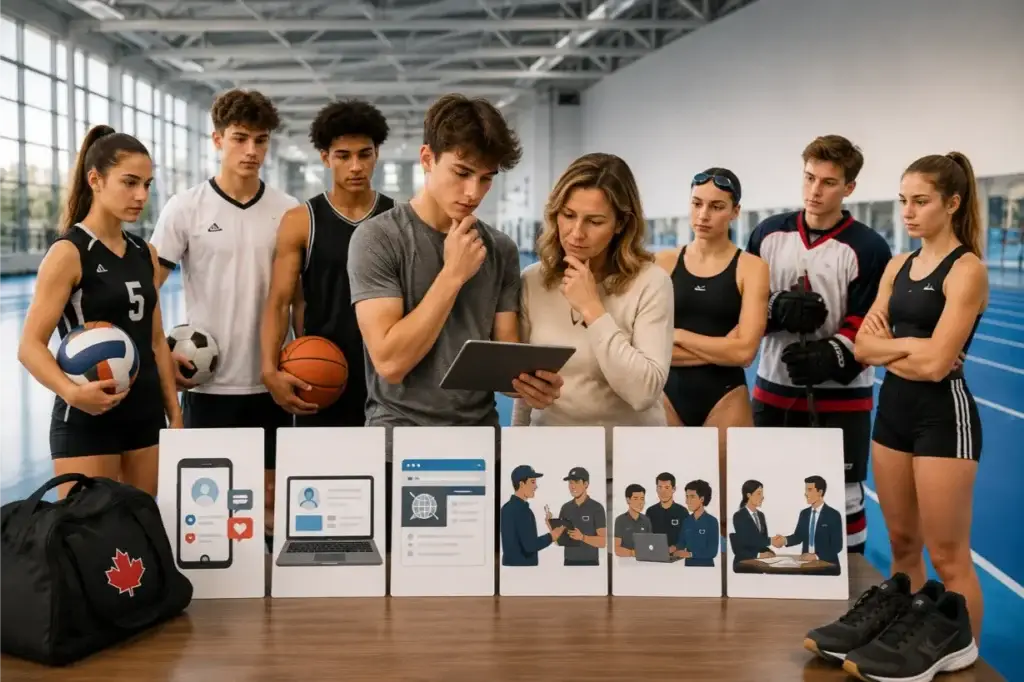
Option 4: DIY with the Help of a Coach or Recruiter (Limited Connections)
Many club, high school, and academy coaches genuinely want to help and will make calls or send emails on an athlete’s behalf, regardless of sport. They will count on their personal connections. They can be strong connections, but limited in exposure.
Cost: Usually free or informal (occasionally a smaller flat fee)
Pros:
- Comes with a personal endorsement, which carries real weight with college coaches
- Often free or low cost
- Coach already knows the athlete’s game, work ethic, and character
Cons:
- Limited to that coach’s personal network; great if it includes the right level programs, unhelpful if it doesn’t
- Coaches are busy with their own team and season; recruiting help is usually a side project for them, not a priority
- No formal accountability, strategy, or guarantee
- Coverage tends to be narrow (a handful of schools, often regional)
Verdict: A strong supplement to other options, especially early on, but risky as your only strategy if your goal is a broad, national search across divisions.
Option 5: Small Recruiting Agency
Independent or boutique recruiting services that manage outreach for a roster of athletes, usually smaller in scale than the major players and sometimes covering only one or two sports, with limited outreach.
Cost: Roughly $1,000–$3,000+ CAD per year, depending on services included
Pros:
- Outreach is handled for you, saving significant time
- Some coach relationships and recruiting know-how
- More personal attention than a mass-market platform
Cons:
- Connections and resources are limited compared to established, larger agencies
- Results and guarantees vary widely: few offer real accountability if outcomes fall short
- Quality depends heavily on the individual running the agency
- A smaller network can mean the same “narrow coverage” problem as Option 4, just paid for
Verdict: Can work well if you’ve vetted the specific agency’s track record and network carefully. Ask for verifiable results before committing.
Option 6: Premium Recruiting Agency, White-Glove, Guarantee-Backed
This is the top tier: an established agency with deep coach networks across NCAA, NAIA, and NJCAA, a full team managing the process, and, critically, a money-back guarantee. In volleyball, for example, Volleyball Athletes, in partnership with StudBud Recruiting Agency, is a model of this approach for Canadian athletes; equivalent sport-specific agencies exist for other sports built on the same principles.
Cost: Higher upfront investment than other options, but structured around performance and risk protection (guarantee-backed).
Pros:
- Genuine “small risk, big reward” model: a money-back guarantee means the agency has skin in the game, not just the athlete’s family
- White-glove service — the agency does the heavy lifting: coach outreach, video/profile packaging, follow-up, negotiation support
- Minimum time commitment required from athletes and parents, which matters enormously during a busy training and school season
- Established network across divisions (NCAA, NAIA, NJCAA) and, where relevant, specialties (like beach volleyball or NIL)
- Track record that can be verified: for example, results reported across dozens of athletes, multiple countries, and millions of dollars in scholarships secured. Check the example on this page.
- Ongoing support through commitment and beyond, rather than a one-time transaction
Cons:
- Highest financial commitment of the six options
- Less “hands-on learning” of the recruiting process for families who want to do it themselves
- Still requires the athlete to perform in their sport and in the classroom; no agency can guarantee athletic or academic outcomes, only the effort and access behind the search
Verdict: The best fit for families who want a serious, national-level search handled by professionals, with financial accountability built-in, and who value their time as much as their money.
How Much Does College Sports Recruiting Cost?
The cost of college recruiting depends largely on how much of the process your family wants to manage.
At one end, athletes can handle almost everything themselves using free tools, coach contact information, social media and a recruiting profile. The financial cost may be low, but the time commitment can be significant.
At the other end, full-service recruiting agencies can manage much more of the process, including college research, profile development, coach outreach, follow-up, applications and offer guidance.
This is why comparing recruiting services based only on price can be misleading.
A better comparison includes both money and time.
Ask:
- Who researches the colleges?
- Who identifies the coaches?
- Who sends the initial messages?
- Who manages follow-ups?
- Who tracks responses?
- Who helps with applications?
- Who helps evaluate scholarship offers?
- How much time will the athlete and parents need to spend each week?
A less expensive option can still be the right choice for a family that has the knowledge and time to manage recruiting. A more comprehensive service may make sense for a family that wants professional support and does not want recruiting to become another part-time job.
Do You Need a Recruiting Service to Get a Scholarship?
No. Athletes can be recruited without hiring a recruiting agency.
Many student-athletes successfully manage the process themselves.
However, doing it yourself means taking responsibility for college research, recruiting profiles, videos, coach outreach, follow-up, eligibility and applications.
The question is therefore not simply whether you need a recruiting service.
If you decide to manage recruiting yourself, a strong recruiting profile is one of the simplest places to start.
How Much Does College Sports Recruiting Cost?
The cost of college recruiting depends largely on how much of the process your family wants to manage.
At one end, athletes can handle almost everything themselves using free tools, coach contact information, social media and a recruiting profile. The financial cost may be low, but the time commitment can be significant.
At the other end, full-service recruiting agencies can manage much more of the process, including college research, profile development, coach outreach, follow-up, applications and offer guidance.
This is why comparing recruiting services based only on price can be misleading.
A better comparison includes both money and time.
Ask:
- Who researches the colleges?
- Who identifies the coaches?
- Who sends the initial messages?
- Who manages follow-ups?
- Who tracks responses?
- Who helps with applications?
- Who helps evaluate scholarship offers?
- How much time will the athlete and parents need to spend each week?
A less expensive option can still be the right choice for a family that has the knowledge and time to manage recruiting. A more comprehensive service may make sense for a family that wants professional support and does not want recruiting to become another part-time job.
Do You Need a Recruiting Service to Get a Scholarship?
No. Athletes can be recruited without hiring a recruiting agency.
Many student-athletes successfully manage the process themselves.
However, doing it yourself means taking responsibility for college research, recruiting profiles, videos, coach outreach, follow-up, eligibility and applications.
The question is therefore not simply whether you need a recruiting service.
If you decide to manage recruiting yourself, a strong recruiting profile is one of the simplest places to start.
How to Choose the Right Recruiting Option for Your Athlete
A few honest questions to ask yourselves, no matter the sport:
- How much time do you and your athlete realistically have each week for outreach, emails, and follow-ups on top of school, training, and competition?
- How wide does your search need to be? A narrow, regional search suits a coach’s personal network. A serious, multi-division, cross-border search usually needs broader infrastructure.
- How much does risk protection matter to you? A guarantee changes the entire cost equation; it’s not just an added cost, it’s a shared incentive.
- What stage is your athlete at? Younger athletes can often afford a slower, cheaper, more exploratory approach. Athletes in Grades 10–12 with a real scholarship timeline benefit more from structured, professional support.
- Does your sport have specialized recruiting infrastructure? Some sports have more sport-specific agencies and databases than others; it’s worth checking what exists for your athlete’s sport specifically before defaulting to a generic platform.
For many Canadian families, the right answer is a hybrid: a solid DIY profile page early on, paired with a premium agency once the recruiting window narrows and the stakes rise.
FAQS
What are the main sports recruiting options for Canadians?
Canadian athletes generally choose from six paths, across most sports: DIY with multiple free accounts, a DIY personal recruiting profile page, a paid DIY recruiting portal/database, help from a coach with limited connections, a small independent recruiting agency, or a premium, guarantee-backed recruiting agency.
DIY sports recruiting realistic for Canadian athletes?
Yes, especially for younger athletes or those with time to dedicate weekly to outreach. It works best when paired with a professional-looking profile page rather than scattered social accounts alone.
How much does sports recruiting cost in Canada?
It ranges widely, from free (DIY multiple accounts) to roughly CAD $100/year for a personal profile page, around USD $600/year for a recruiting portal subscription, and higher for agency-managed services, with premium guarantee-backed agencies representing the largest but most risk-protected investment.
What does a money-back guarantee mean in sports recruiting?
It means the agency shares financial risk with the family. If the promised recruiting outcomes aren’t delivered, part or all of the fee is refunded, which incentivizes the agency to do real, effective work rather than simply collecting a fee.
Do Canadian athletes need a U.S.-based agency to get recruited?
No, but working with an agency experienced specifically in cross-border, Canada-to-U.S. recruiting (NCAA, NAIA, NJCAA eligibility, transcripts, visas, etc.) tends to smooth out issues that purely U.S.-based or purely DIY approaches often miss.
Regardless of whether an athlete uses an agency or manages recruiting independently, NCAA, NAIA and NJCAA eligibility requirements should always be verified through the applicable official organization and the college’s athletics or compliance staff.
When should a Canadian athlete start the recruiting process?
Most athletes benefit from starting exploratory steps (profile page, highlight video, initial research) around Grade 10, with more serious, structured outreach ramping up by Grade 10–11 depending on the target division and sport.
Does the right recruiting option depend on the sport?
Somewhat. The six paths apply across sports, but the depth of sport-specific infrastructure (agencies, databases, showcases) varies; some sports, like volleyball, have more mature, specialized recruiting ecosystems than others.
Can you combine recruiting options
Yes, many successful athletes start with a DIY profile page early on and later move to a premium agency once they’re closer to their commitment window. The options aren’t mutually exclusive.
Official Eligibility Resources
NAIA International Student Eligibility
Not sure which path fits your athlete? Schedule a no-obligation call with our team to talk through your options. (You will have to open an account first)